Blog
The $50 Billion Prompt Tax: Why Your Developers Are Wasting 2 Hours Per Day
AgileAI Labs | December 18, 2025
Do the math with me for a second.
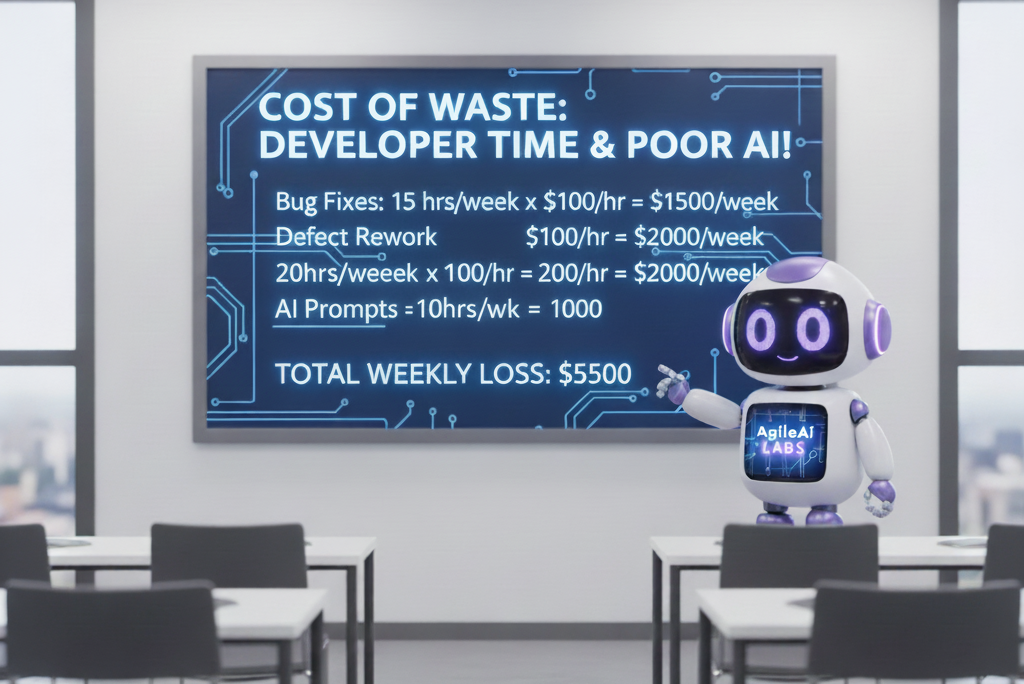
If you have a development team of 100 engineers, and each one spends just 2 hours per day crafting prompts for GitHub Copilot, ChatGPT, or Claude—pulling context from Jira, digging through Confluence docs, copying acceptance criteria, hunting down architecture guidelines—that's 200 hours. Per day.
Over a year, that's 52,000 hours.
At an average fully-loaded cost of $150K per developer, you're spending $3.9 million annually just on prompt preparation.
Scale that across the industry, and we're talking about a $50 billion prompt tax that enterprises are paying without even realizing it.
The Invisible Tax on AI-Assisted Development
Here's the irony: AI coding tools were supposed to eliminate toil. Instead, they've created a new category of it.
Every morning, developers open their IDE with the best intentions. They grab a user story from Jira. They pull up the acceptance criteria. Maybe they check Confluence for the API standards. Maybe they remember to reference that security checklist the team created last quarter. Maybe they don't.
Then they flip over to Copilot or ChatGPT and start typing. Not code—prompts. Long, detailed, hand-crafted prompts that attempt to synthesize all that fragmented context into something an AI can work with.
It's mentally exhausting. It's inconsistent. And it's happening thousands of times per day in every engineering organization that's adopted AI coding tools.
The Four Hidden Costs
The time spent is just the beginning. The real costs run deeper:
- Inconsistency Across Teams
Every developer writes prompts differently. One person includes security requirements. Another forgets. One references the team's coding standards. Another wings it. The AI generates code based on whatever prompt it receives—which means your codebase is accumulating inconsistency at machine speed.
- Lost Context
Your organization's knowledge is scattered. Requirements live in Jira. Standards live in Confluence. Architecture decisions live in design docs. UI intent lives in Figma. Code patterns live in repos. When a developer writes a prompt, they're manually stitching together 10–20% of the context that actually matters. The other 80% gets lost in translation.
- The Governance Gap
There's no audit trail. No evidence that your security policies or design standards were included in the prompt that generated that code. Compliance teams are starting to ask questions—rightfully so—and engineering leaders don't have good answers. "We told developers to include security considerations" isn't going to fly in a SOC 2 audit.
- Invisible ROI
Your company invested in AI coding tools. Are they working? Nobody knows. You can't measure time-to-first-PR. You can't track whether acceptance criteria are being met on the first submission. You can't connect AI-assisted work to improvements in lead time or defect rates. The prompts are ephemeral—typed into a chat box and lost forever—so you can't analyze what's working and what isn't.
Why This Is Getting Worse, Not Better
As AI coding tools get more powerful, the prompt tax actually increases.
Developers are now expected to provide more context, more constraints, more examples. "Generate a React component" isn't enough anymore. Now it's: "Generate a React component that follows our design system, uses our standard error handling patterns, integrates with our logging framework, passes our accessibility requirements, and includes both unit and integration tests."
That's not a prompt. That's a requirements document disguised as a chat message.
And developers are writing dozens of these per week.
The Missing Link
The frustrating part? All that context already exists.
It's sitting in your requirements management system, your test suite, your standards documentation, your architecture diagrams. It's been curated, reviewed, and approved. It's your organization's system of record.
But there's no bridge between that system of record and the AI tools your developers actually use.
So instead of leveraging existing, high-quality context, developers are forced to manually reconstruct it—imperfectly, inconsistently, and repetitively—every single time they want AI assistance.
It's like having a library full of books, but making everyone re-type the book they need because the printer isn't connected.
What If…
What if your requirements system could generate those prompts automatically?
What if every user story came with IDE-ready, context-rich, standards-compliant prompts that developers could use immediately—no reconstruction required?
What if those prompts included:
- Defect-reduced, enhanced requirements (not just the raw ticket)
- Your organization's security and design standards
- Relevant code patterns and architectural context
- Test models and acceptance criteria
- Full traceability for compliance and audit
What if you could measure, for the first time, the actual ROI of AI coding—because every prompt was tracked, every output was tied to requirements, and every improvement was quantifiable?
What if the 2 hours per day your developers spend crafting prompts could be redirected to actual engineering?
The Last-Mile Problem
This is what we're calling the "last-mile problem" in AI-assisted development.
The tools are here. The requirements are solid. The standards are documented. But the gap between "approved requirements" and "AI-generated code" is still being bridged manually, inefficiently, and at enormous hidden cost.
At AgileAI Labs, we've spent the last several months thinking deeply about this problem. And we're building something to solve it.
Not a replacement for your AI coding tools—an enabler. A way to turn your existing requirements, standards, and test assets into governed, traceable, IDE-ready prompts that work with the tools your developers already love.
We're calling it Developer Prompt Packs. And we think it's going to change the conversation around AI-assisted development.
More details coming soon. But if you're an engineering leader who's felt the prompt tax eating away at your team's velocity—or a CTO wondering how to govern AI coding at scale—this one's for you.
Follow AgileAI Labs for updates. The future of AI-assisted development isn't faster typing. It's smarter inputs.
—